
Retaining Wall Replacement in the Taunton Area
Some walls are past repair. When the face has rotated or the base has washed out, patching moves the failure a few feet down the wall. At that point replacing the whole wall is the repair that lasts.
Retaining wall replacement means taking the old wall out and building a new one sized for the soil behind it. Some older walls were built without drain stone or any reinforcement, so a rebuild can fix problems the original never solved. A good contractor explains why the old wall failed before building the next one.
Signs a Wall Is Past Repair
A wall that leans outward along most of its length has usually lost its base or its drainage. Resetting one section doesn't help when the rest is moving too. Wide cracks that run from top to bottom tell the same story.
Timber walls give their own warning. Soft, crumbling wood and rusted or loose fasteners mean the structure has lost strength, and timber tends to rot out sooner than stone or block.
If you've patched the same wall more than once and it keeps shifting, the cause is still there. Replacement lets the contractor correct the base and the water problem together.
How a Tear-Out and Rebuild Works
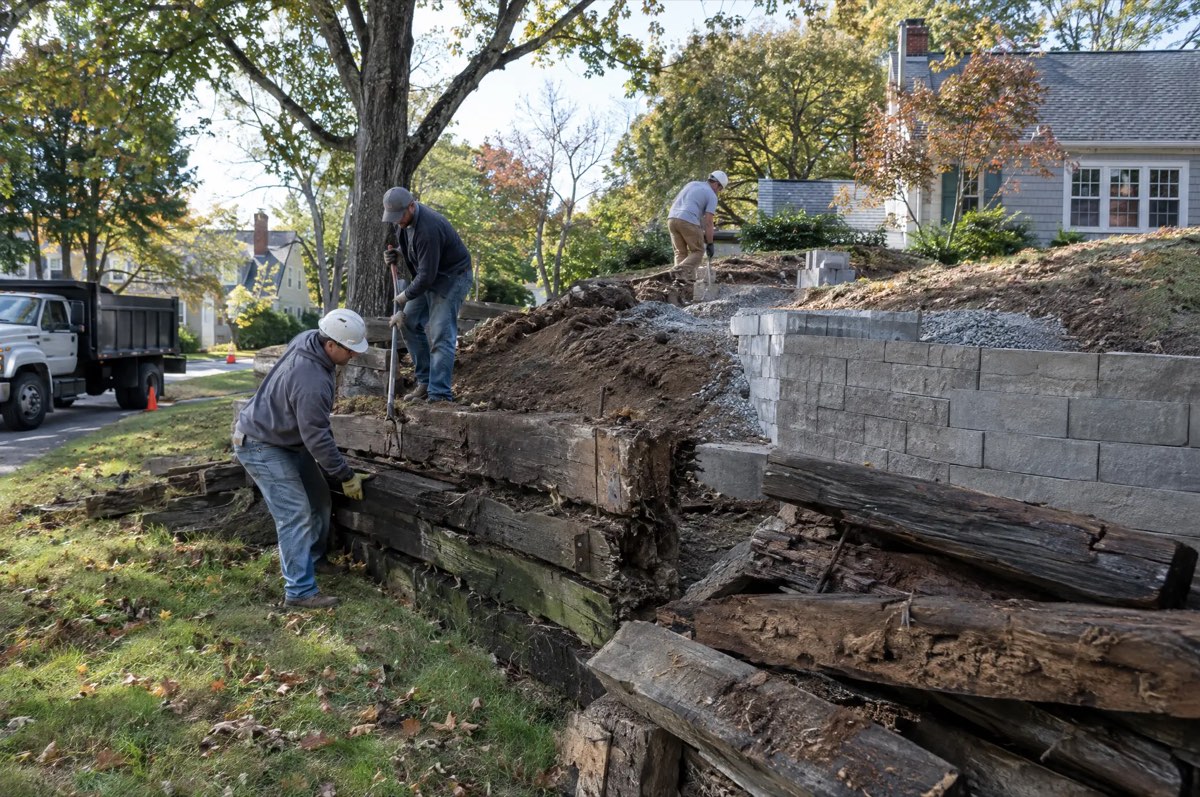
The old wall comes down in sections so the slope doesn't slide while the wall is open. Sound stone or block can be sorted for reuse, and broken pieces get hauled away. Rotted timbers and old fill come out too.
Then it's a new build. The excavation is reset to the right depth, the base is compacted crushed stone, and the courses go up with drain pipe and clean gravel behind them. Soil is backfilled in layers, and the wall gets a cap.
A rebuild is the moment to fix the reason the wall failed. A wall that gave out from trapped water needs drainage added, and a wall that sat on a narrow base needs a wider one. Ask how the new design differs from the old wall and why.
Variables That Shape a Tear-Out and Rebuild
The size of the old wall sets the amount of material to remove and replace. A long, tall wall means more debris and more soil to hold in place during the work, and taller walls commonly need a permit or engineered plans.
Some owners rebuild in the same material, and others switch from timber to block or stone for a longer life. Walls close to a house, driveway, or property line may need temporary support while the old wall is out.
A machine that can reach the wall speeds up demolition and hauling. Ask for a written scope covering removal, base, drainage, and the new wall, so you know what the quote includes.
Signs it is time to call
- The wall leans or bulges along most of its length
- Wide cracks run from the top of the wall to the bottom
- Timbers are soft, rotted, or pulling away from their fasteners
- The same wall has been repaired before and is moving again
- The base has washed out or the wall is sinking at one end
Retaining Wall Replacement questions
How do I know if I need a replacement instead of a repair?
If the damage is limited to one section and the base is sound, repair can work. If the wall leans along most of its length, the base has failed, or earlier repairs haven't held, replacement is the better call. A contractor can check this on site.
Can the old stone or block be reused?
Often some of it can. Sound pieces get sorted and set aside, while cracked or crumbling material is hauled off. How much is reusable depends on the wall's condition and the original material.
How long should a new retaining wall last?
That depends on the material, the base, and the drainage. Stone and block walls built on a compacted base with proper drainage tend to outlast timber. Ask your contractor what lifespan to expect for each option.
Other services
Ready when you are
If your Taunton wall keeps shifting after repairs, call Taunton Retaining Walls to find out whether a rebuild makes sense. We'll walk through why the wall failed and what a replacement would involve.
Call (508) 209-5020